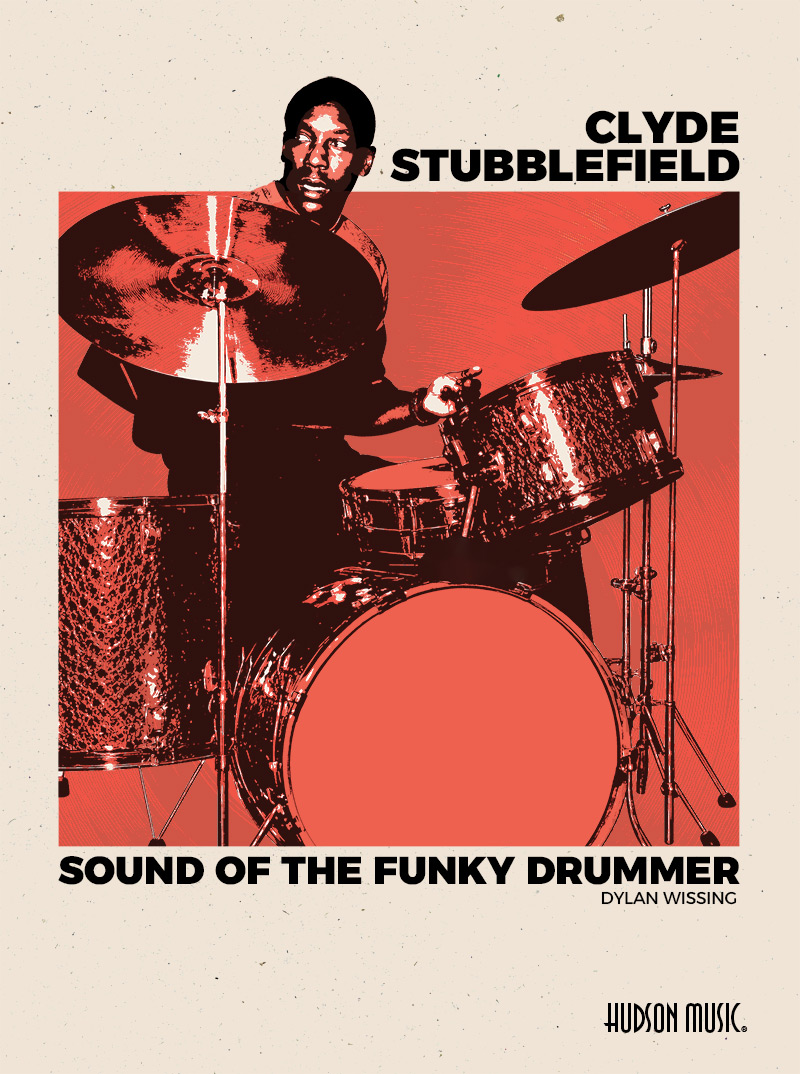
The definitive biography of Clyde Stubblefield, over 350 pages, full color with rare photos and note-for-note transcriptions.
On November 20, 1969, James Brown and his band recorded a mostly-improvised
Wissing’s Clyde Stubblefield: Sound of the Funky Drummer highlights how Stubblefield changed the way we think about the musical contributions of a drummer. As one of the creators of funk music in the ‘60s, Clyde’s drum tracks were present at the inception of hip hop in the early ‘70s, became the world’s most-sampled breakbeat in the ‘80s, were crucial to founding entirely new musical genres in the ‘90s, and continue to influence musicians, songwriters and music production globally to this day.
As one of the defining drummers of funk and the performer of one of the most sampled drum breaks in history, Clyde Stubblefield is among the most important drum set artists in history. Wissing’s Clyde Stubbfield: Sound of the Funky Drummer is the definitive biography of Stubblefield, his drumming, and the importance of the Funky Drummer break in music history.
The book is broken into several sections which cover Clyde and his work in extensive detail. The first section is a biography, followed by interviews about Clyde’s life with people who knew, worked with, or were influenced by him, including Jody Hannon, Alan Leeds, Harry Weinger, David Garibaldi (Tower of Power), Dennis Chambers, Michael Bland (Prince), Ben Sidran, and others. This is followed by musical transcriptions and analysis of over 20 classic grooves and tracks, including Cold Sweat, Give It Up Or Turnit A Loose, I Got The Feelin’, Soul Pride, and many others. There is also other educational content based around Clyde’s style.
The book is broken into several sections, covering Clyde and his work in extensive detail:
A biography of Clyde includes in-depth interviews with people who knew, worked with, and were influenced by him, including Clyde’s wife Jody Hannon, music industry heavyweights Alan Leeds and Harry Weinger, drummers David Garibaldi, Dennis Chambers, Michael Bland, Sput Searight and Adam Deitch, and composers/producers Ben and Leo Sidran.
Musical transcriptions and analysis examine over twenty classic grooves and tracks from Clyde, including Cold Sweat, Give It Up Or Turnit A Loose, I Got The Feelin’, Soul Pride, and many deep cuts. Also included is educational content based around Clyde’s style and approach, with significant contributions from Clyde’s longtime student and friend David Stanoch.
A full history of the Funky Drummer recording session includes a comprehensive analysis of Clyde’s drumming, in-depth transcriptions, exercises to build up the unique techniques Clyde used that night in the studio, and thoughts from Questlove on the importance of the track.
Detailed information on the instruments that Clyde played with James Brown, as well as later in his career when he was based in Madison, Wisconsin.
Extensive exploration of Cincinnati’s King Records and their in-house studio, where so many legendary James Brown tracks were recorded. Producer Ken Lewis, historians and audio experts Yemi Oyediran and Randy McNutt, and engineers Richard Adlam and Rick Carson analyze how the unique sonics of the iconic Funky Drummer break were created, covering everything from the layout of the room, microphones, console and outboard gear to musician placement, signal flow and post-production work.
The importance of Clyde Stubblefield and his breakbeats in the birth and growth of hip-hop, jungle and drum ’n’ bass are discussed in detail with producers Hank Shocklee and Just Blaze, filmmaker Trevor Banks, and engineer Nick Sansano.
Professor Matt Brennan illuminates the historical importance and impact of the drum set overall, as well as the complicated copyright and ownership issues around Clyde’s musical creations as he became one of the world’s most-sampled drummers.
A comprehensive discography of every known recording and video appearance from Clyde’s long career.
Musicians, recording engineers, producers, music history buffs, James Brown fans, hip-hop aficionados, and anyone interested in key recordings in music history will find this book a compelling and complete analysis of a drummer, drum break, and the intense musical environment around James Brown. It is certainly the definitive work on the Funky Drummer himself, Clyde Stubblefield.
Print or Digital Book | 364 pages
Playlists
Suggested listening for each chapter of the book!
Part 1: Life
Part 2: Coming Soon
Part 3: Transcriptions
Part 4: Funky Drummer Recorded Variations
Part 5: Recording
Part 6: Clyde & Sampling
I’m blown away…Clyde Stubblefield has been a long time influence and inspiration. This book is a microscopic look at one of the most influential drummers in the modern era. For me, there’s Max Roach, Tony Williams, Elvin Jones and Clyde Stubblefield. Dylan has done exhaustive research and in the book are stories, interviews and the best part, transcriptions. A tremendous effort, it’s like a college course on one of the major architects of the language of funk drumming. Brother Dylan, thank you for doing this!”
- David Garibaldi
Clyde Austin Stubblefield (April 18, 1943 – February 18, 2017) was an American drummer best known for his work with James Brown, with whom he recorded and toured for six years (1965-70). His syncopated drum patterns on Brown's recordings are considered funk standards. Samples of his drum performances (particularly his break in the 1970 track "Funky Drummer") were heavily used in hip hop music beginning in the 1980s, although Stubblefield frequently received no credit.
A self-taught musician, Stubblefield was influenced by the sound of industrial rhythms he heard in factories and trains. He began playing with local groups in his native Tennessee and later moved to Georgia, where he played with musicians such as Eddie Kirkland and Otis Redding in the early 1960s before joining Brown's band. He later settled in Madison, Wisconsin, where he was a staple of the local music scene. He has been named among the greatest drummers of all time by various publications. Rolling Stone placed him tied with his bandmate Jabo Starks at number 6 on their list of "100 Greatest Drummers of All Time". In 2017, he accepted an honorary degree from the University of Wisconsin–Madison.